

-
Woodards House
Level 1, 47 Waymouth Street
Adelaide, SA 5000, Australia - +61 8 8410 5222
- [email protected]
Ask an international student who came to study English in Adelaide what they miss most after they go home. It’s rarely the classroom. It’s rarely even the English course itself.
It’s Saturday morning at the Central Market. It’s watching the sun go down at Glenelg. It’s that moment during Fringe when the whole city feels like it belongs to you.
Adelaide stays with you in a way that bigger, louder cities don’t. The students who know this chose it deliberately. Here’s what they found.
Adelaide Central Market has been trading since 1869. Today it holds more than 70 traders from over 40 nationalities under one roof, one of the most diverse food markets in Australia. It draws millions of visitors a year, remarkable for a city of 1.4 million people.
For international students, this matters more than it sounds. Being far from home is manageable. Being far from your food is harder. At the Central Market, students from across Asia, the Middle East, Europe, South America and Africa regularly find something that connects them to home: a spice, a pastry, a preparation method they recognise.
Beyond the familiarity, the market is a weekly ritual. Produce is genuinely affordable, and the coffee is as good as anything you’d find in a bigger city. On a Saturday morning, when it feels like the whole city has turned up, there’s nowhere else in Adelaide quite like it. It’s also one of the best places to practise English. Every stallholder is there to talk, to recommend, to tell you where the produce came from. Nobody’s too busy.
Sydney has over 5 million people. Melbourne isn’t far behind. Adelaide has 1.4 million, and that difference is felt every day.
You don’t spend an hour commuting to reach a beach, a park, a market or a restaurant. Most of what the city offers is within 20 to 30 minutes by public transport or bike. The CBD is compact and walkable, and free trams run through the city centre between South Terrace, the Botanic Gardens and Festival Plaza. A separate free tram service also covers the Glenelg end of the line, between Brighton Road and Moseley Square, so getting to the beachfront itself doesn’t cost a thing once you’re there. The stretch connecting the city to Glenelg still needs a regular Adelaide Metro fare, and international students qualify for the same concession pricing as domestic students.
It’s also cheaper to live in than the bigger cities. Most students here budget somewhere in the range of AUD 350 to 700 a week for living costs, depending on lifestyle and accommodation, and student visa holders can currently work up to 48 hours a fortnight during term to help cover it.
Students who’ve lived in Sydney or Melbourne often describe Adelaide as the city where they finally had time. Time to cook, to explore, to build friendships, to do the things that make somewhere feel like home rather than just somewhere you’re surviving.
Know more about free trams and concession transport.
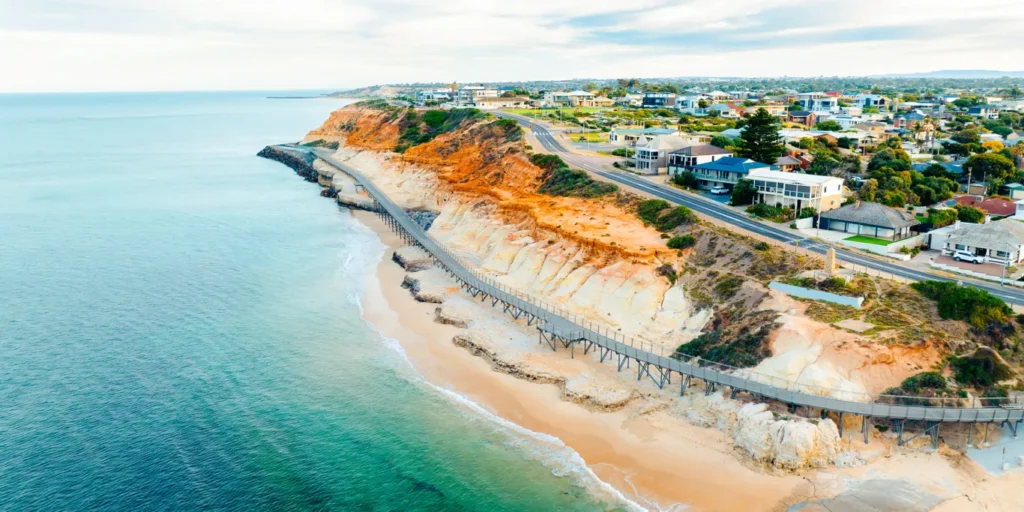
Adelaide’s coastline runs 70 kilometres along the city’s western edge. It’s not a day trip. It’s a Tuesday afternoon.
Glenelg Beach, white sand and clear water, is 20 minutes from the city centre by tram. Henley Beach is quieter, Semaphore suits paddleboarding, and Largs Bay is known for its sunsets. Port Noarlunga even has a reef you can snorkel. Entry to all of them is free.
For students from landlocked countries, this kind of access to open water changes things. For students from coastal cities, Adelaide’s beaches deliver without the crowds you’d find at a major international tourist hub. That outdoor access has a real, measurable effect on mood, energy and how well you study.
Know more about the best beaches in Adelaide.
Adelaide is a genuine festival city. Students arriving in the first half of the year land in one of the busiest stretches of cultural events in the Southern Hemisphere.
Adelaide Fringe, the world’s second largest arts festival after Edinburgh, fills the city through February and March with street performances, comedy, theatre, music and visual art. WOMADelaide brings world music, dance and food from across the globe to Botanic Park for four days in March, a lineup that genuinely reflects the diversity of Adelaide’s international student community. OzAsia Festival, dedicated to theatre, dance, music and food from across Asia, runs later in the year. And Tasting Australia showcases South Australian food and wine across hundreds of events.
These aren’t small, niche events tucked away somewhere. They’re city-wide moments when Adelaide feels genuinely alive, and they give language students endless chances to talk to strangers and use English in real, unscripted situations.
This sounds small. It isn’t. In cities with a huge international student population, it’s possible to go months without a real conversation with an Australian outside your school. The international student community can turn inward without meaning to.
Adelaide’s different. The international student population is spread more evenly across the city, so locals still notice and talk to students from overseas, rather than looking straight past them. At the pub, on the tram, in the queue at the Central Market, at a Fringe show, people talk to you. That’s a kind of practice no textbook replaces. Students who live here describe conversations with locals as a normal part of the week, not something rare.
Adelaide is Australia’s first, and only, UNESCO City of Music, a status it’s held since 2015. Music, art and culture show up in everyday city life here, not just during festival season. On the food side, Adelaide is often called Australia’s food and wine capital. South Australian wine regions has 13 wine regions, including the Barossa Valley, McLaren Vale and Clare Valley, all within 90 minutes of the city.
Within the city itself, Adelaide has more restaurants and cafes per resident than any other Australian state. Students on a budget eat well here. Good food isn’t locked behind expensive menus. It’s at the market, or at the Vietnamese, Lebanese or Italian place that’s been running for decades. For international students, food and culture aren’t separate from language learning. Every conversation over a meal is language in use.
Adelaide gets thousands of hours of sunshine a year and a Mediterranean climate: hot, dry summers and mild winters, with low rainfall.
That matters more than it sounds when you’re a long way from home. Sunlight and time outdoors have a proven effect on mood, energy and motivation. Students in grey, wet climates often report more homesickness and a harder time keeping up study routines. In Adelaide, the default weekend option is to go outside, to the beach, the hills, the market, a park. Students who stay active and socially engaged outside class are consistently better language learners. The weather isn’t a bonus feature. It’s part of what makes studying English in Adelaide work.
Most students budget around AUD 350 to 700 a week, covering accommodation, food and transport. That’s generally lower than Sydney or Melbourne.
Student visa holders can currently work up to 48 hours a fortnight during term.
Partly. The city centre tram loop and the short Glenelg beachfront stretch (Brighton Road to Moseley Square) are free. Travelling the full distance between the city and Glenelg needs a paid fare, though international students get concession pricing on Adelaide Metro.
SACE General English courses run from one week up to 48 weeks, so you can build a course around a short trip or a longer stay.
Adelaide consistently ranks among the safer Australian capital cities, with a compact, walkable CBD and a lower crime rate than Sydney or Melbourne. As anywhere, normal city precautions apply.
Arriving in the first half of the year puts you in Adelaide for Fringe and WOMADelaide (February to March), the city’s busiest cultural stretch. OzAsia Festival and Tasting Australia run later in the year if you arrive after mid-year.
No. Glenelg is reachable by tram in 20 minutes, and most other city beaches are a short bus or bike ride away. A car helps for day trips further out, like Port Noarlunga or the Adelaide Hills, but isn’t essential for everyday student life.
Please Login To Add Wishlist